NPR's recent story "Chlorine Substitutes in Water May Have Risks" is a little upsetting. It would be a lot more upsetting, though, if I lived in one of the many states where water treatment plants have started using Chloramine (Chlorine + ammonia) as primary water disinfectant in response to recent EPA guidelines. Apparently Chlorine (what has been predominantly used in the past) actually produces small levels of carcinogenic byproducts. Cancer is a bad thing, so the EPA recently advocated the use of Chloramine. Good, right? Nope.
In Washington D.C. health officials have discovered that Chloramine not only produces nitrasomes, a carcinogen much more harmful than the after-effects of Chlorine, but fails to prevent lead from leaching into the local water supply. "Unheard-of" lead levels started to appear in D.C. water districts and in D.C. children. Apparently, problems with Chloramine may manifest differently or not at all across the country, depending on the reactions of individual water systems, and many companies will be reticent to make the high-cost switch back to Chlorine. That's a big, fat, expensive question mark.
Whether it's because Utah is slow on the uptake, dislikes the EPA in general or just has really good judgment, we're still using chlorine. Is that all good? According to NPR, "There are still good reasons for many water systems to move away from chlorine...but [Sedlak] says local authorities need to remember that a new disinfectant may bring its own problems." If Utah does decide to make a change, hopefully we'll learn from the mistakes of our neighbors. More importantly, I hope that US citizens will become AWARE of environmental changes in progress and not just react to them after the fact.
cool background.

Tuesday, January 11, 2011

Friday, December 17, 2010
read my other blog!
So, I just posted my term paper, called "the fallow garden," on sunbursts 21. I'd really like comments and advice should you feel like wading into the depths of literary analysis.
: )
did I mention that I wrote a term paper and now I'm DONE????!!!
Because I am. Oh, I love Christmas so much...
Happy Holidays!
: )
did I mention that I wrote a term paper and now I'm DONE????!!!
Because I am. Oh, I love Christmas so much...
Happy Holidays!
Sunday, December 5, 2010
the song in my head.
Yes, it's cheesy. Get over that and let it make you happy. : )
"Love Only Knows," Josh Groban
I've tried to hold this back so long
and we're always such a good thing when its gone
would it be alright if we just left our heads tonight
take me away from this old game
of saying we're both too much the same
would it be alright if i just stayed with you tonight
and before I go, will i ever see you again
she said love only knows
love only knows if we'll give into fear and choose life undercover
she said love only knows if its special enough that we'll choose one another
choose each other
You were the secret I loved keep
the name i would only sing in my sleep
would it be alright if we just lose ourselves tonight
and if you let go, will you reach out again
[ From : http://www.elyrics.net/read/j/josh-groban-lyrics/love-only-knows-lyrics.html ]
she said love only knows
love only knows if we'll give into fear and choose life undercover
she said love only knows its special enough that we'll choose one another
we'll choose each other
and i can't breath with out you and i don't, and I can't live without love and I won't... and I won't
Love only knows if we'll give into fear and choose life undercover
she said love only knows if its special enough that we'll choose one another
oh, love only knows how your arms pull me in like the tide pulls me under
she said love only knows just how long we can run before we lose each other
and we need each other
and i can't live without you and I won't
and we're always such a good thing when its gone
would it be alright if we just left our heads tonight
take me away from this old game
of saying we're both too much the same
would it be alright if i just stayed with you tonight
and before I go, will i ever see you again
she said love only knows
love only knows if we'll give into fear and choose life undercover
she said love only knows if its special enough that we'll choose one another
choose each other
You were the secret I loved keep
the name i would only sing in my sleep
would it be alright if we just lose ourselves tonight
and if you let go, will you reach out again
[ From : http://www.elyrics.net/read/j/josh-groban-lyrics/love-only-knows-lyrics.html ]
she said love only knows
love only knows if we'll give into fear and choose life undercover
she said love only knows its special enough that we'll choose one another
we'll choose each other
and i can't breath with out you and i don't, and I can't live without love and I won't... and I won't
Love only knows if we'll give into fear and choose life undercover
she said love only knows if its special enough that we'll choose one another
oh, love only knows how your arms pull me in like the tide pulls me under
she said love only knows just how long we can run before we lose each other
and we need each other
and i can't live without you and I won't
Monday, November 22, 2010
It's (almost) Friday. Except you think it's Tuesday.
Did you know that the Beatles were largely responsible for the downfall of Communism in Russia?
Or that that the Canterbury tales were written in accentual-syllabic meter (specifically, generally iambic pentameter with occasional breaks of trochaic pentameter or an extra syllable)?
Or that Zachary Levi got his start in musicals at the age of 6?
Neither did I. Now I do, though, which makes me wonder...what's the point? Why do we learn? I enjoy it for sure (well, almost always,) but does it actually help me to know what years the Tudors were in power?
Of course you could make the argument that those years are important for understanding the historical context of British literature from that time period. But if that's true, shouldn't I bet trying to memorize every ruler for the past (*insert length of time since writing began) years in every country where there were significant contributions to literature? Which, of course, begs the question "what is significant literature"?
Here's a stab at an answer - note that although I do not claim to have all or any of the answers, I have recently decided that I am still going to try and find answers.
I think that stories make us who we are, and that the most critical information is "that which edifieth"; information that connects to what we already know and lights up the huge space of the universe a little bit more than it its. In this case, any knowledge can be valuable - if knowing that Zachary Levi started his acting career by singing in musicals connects to something you already know and allows to you start understanding a pattern in human existence, go you. You study that celebrity culture. I think the most important patterns (or lack of patterns) of human existence are all related, so here's my "information wanted" sign:
Or that that the Canterbury tales were written in accentual-syllabic meter (specifically, generally iambic pentameter with occasional breaks of trochaic pentameter or an extra syllable)?
Or that Zachary Levi got his start in musicals at the age of 6?
Neither did I. Now I do, though, which makes me wonder...what's the point? Why do we learn? I enjoy it for sure (well, almost always,) but does it actually help me to know what years the Tudors were in power?
Of course you could make the argument that those years are important for understanding the historical context of British literature from that time period. But if that's true, shouldn't I bet trying to memorize every ruler for the past (*insert length of time since writing began) years in every country where there were significant contributions to literature? Which, of course, begs the question "what is significant literature"?
Here's a stab at an answer - note that although I do not claim to have all or any of the answers, I have recently decided that I am still going to try and find answers.
I think that stories make us who we are, and that the most critical information is "that which edifieth"; information that connects to what we already know and lights up the huge space of the universe a little bit more than it its. In this case, any knowledge can be valuable - if knowing that Zachary Levi started his acting career by singing in musicals connects to something you already know and allows to you start understanding a pattern in human existence, go you. You study that celebrity culture. I think the most important patterns (or lack of patterns) of human existence are all related, so here's my "information wanted" sign:
Seeking enlightenment. Will accept any form of assisting knowledge,
including how grasshoppers harmonize their chirping. Prefers
stories.
(I think stories are more often true than "facts" because they aren't trying to be.)
including how grasshoppers harmonize their chirping. Prefers
stories.
(I think stories are more often true than "facts" because they aren't trying to be.)
Happy thinking and Thanksgiving, readers.
Love, Jessie
Love, Jessie
Friday, November 12, 2010
It's Friiiiidayyy
(The wife of Bath)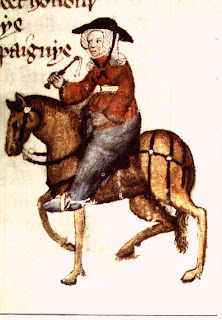
Dear reader,

Dear reader,
Today I am grateful for weekends. What a good idea! Who thought them up? Does anyone know, actually, where the weekend originated?
*ahem.* I would like to share a line from "The Wife of Bath" (part of the Canterbury Tales) that made me ponder. Describing her relations with her many husbands, the Wife exclaims that "We wommen han, if that I shal not lye
In this matere a queynte fantasye.
Wayte, what thyng we may nat lightly have,
Thereafter wol we crie al day and crave!
Forvede us thyng, and that desiren we:
Presse on us faste, and thanne wol we fle" (515-20).
The gist of this passage is that women will always seek after what you deny them, and undervalue what they're given. Although I think this argument could be made about men as well, I'm curious what it is about women (or people) that seeks after the difficult and the unobtainable. What about that difficulty makes the end result more valuable?
Along that line, does it follow that people should make love continually difficult to obtain for their partner? That seems a little counter-productive to me. Perhaps after a certain time period you can stop "playing hard to get."
Thoughts?
Thursday, November 11, 2010
Back in Black
To whomever reads this blog:
I am (once again) officially returning to the blogging stage. Although I'll continue to publish my personal projects (photos and writing) on sunbursts21@blogspot.com, this blog is about feel the cleansing fire of a political reformation.
Prepare yourself. : )
Wednesday, May 12, 2010
Spanish tricks

Language List
I took Spanish lessons for the majority of my time in Argentina, and also put a great deal of effort into listening to the individualities of Spanish in that country. Through these mediums I developed a list of 50 different clichés, metaphors, sayings and significant phrases in Argentine Spanish. Here is my list:
1) No por mucho madrugado el almacén llegará mas temprano. – “Getting up early a lot will not make the sun rise any faster.” This phrase suggests to me the relaxed, more peaceful attitude of the Latin American culture. Since our actions will not change the spin of the universe, we should enjoy life as it comes.
2) Principe Azul – “Blue Prince.” This phrase is analogous to “white knight.” It is, apparently, a universal phenomenon to look for “the one perfect guy.”
3) Pega un Ducha – “Beat/hit a shower.” It’s a play on words that suggests taking a shower quickly.
4) Cuestión de Piel – “A question of skin.” This suggests the idea that you cannot know how much chemistry you have with a person until you have touched them.
5) Círculo de 99 – “Circle of 99.” This refers to inescapable discontentment, and is the title of a story about a King who finds that the way happiness is destroyed by chasing the last, missing thing you don’t have.
6) Gallego – “Someone from Galicia.” Early Spanish colonists were uneducated and uncivilized, and so this is a stereotypical phrase for any Spaniard implying they are dumb.
7) Que sé yo – “What do I know.” This is an informal conversation filler used in casual and uneducated speech, i.e. “We could play, I don’t know…Frisbee?”
8) Poner passion – “Put passion.” This is the equivalent of “put your heart into it.” It is the idea of giving your emotion to something to make it worthwhile.
9) Cursi – “Pretentious.” This is the equivalent of “cheesy” or “melodramatic,” used for both people and entertainment.
10) Que lo pasan bien – “That it passes well to all of you.” This is a parting phrase used to signify “have a good time.”
11) La suerte está echada – “The luck is thrown.” This is a metaphor that is used to signify that your luck in life, good or bad, is already set and going to happen.
12) Bichos de ciudad – “City bugs.” This references people who live in cities with lots of other people and crawl around like bugs; i.e., “city slickers.”
13) Porteños – This means people from the Port, or Buenos Aires. There is a stereotype in Argentina that people from the big city are uppity, ignorant and self-centered.
14) Golpe del Estado – “Hit the state.” This means “coups,” and is used in Argentina specifically to reference March 24th, 1976.
15) Nunca Más – “Never More.” This famous phrase said in a courtroom trial of the leaders of the 70’s junta carries weight, as it is always associated with that terrible time, and the determined emotion to never let something happen again.
16) Estoy a mil por hora – “I am a thousand per hour.” This is used like “I’m going 60 miles a minute.”
17) Tal Cual – “So what.” This phrase means “Exactly so,” and is used frequently to agree that someone has been accurate or say ‘”how things are.”
18) Difunta del Correo – “Death of Correo.” This phrase describes the famous death of a virgin who trekked across the desert with her infant child, and died of thirst but saved the child by giving it her milk. There are sanctuaries for her along most major roads in Argentina.
19) Gauchito Gil – Another source of roadside sanctuaries, “Guachito Gil” is a robin hood character in Argentine legend who stood up for the country people and the gauchos by robbing the wealthy. Many rural Argentines regard him as a saint.
20) Si o si “If or if, “ or “yes or yes.” This phrase is commonly used to mean “For sure,” i.e., “I will be at the movies tonight si o si.”
21) Es una rata – “He’s a rat.” This metaphor is used to describe someone who is very thrifty.
22) Hace la cabeza – “Make/do the head.” This phrase means to convince somebody.
23) Rompe la boca o te tranza – “Break your mouth, or entrance you.” These two phrases are both used for kissing, which seems to suggest the alternate ideas of romance and male female relations in Argentina. Men are still given predominant authority, and violence is a serious issue, but Argentine women have definitely come into the modern era of work and play.
24) Se calienta – “he gets hot.” This phrase means, “He gets mad.” The analogy is often used in English, as well.
25) Está re-pila – “He’s very batteried.” The equivalent of “he’s wired,” this phrase describes someone who is being unusually active.
26) Pedir que lo tiren – “Ask that they throw you.” This phrase is used as “ask them to give you a ride.” Throw is a modern substitution for take.
27) Un amigo de fierro – “A friend of steel.” This metaphor is used to describe someone who will be a true friend “through thick and thin.” This is an important phrase, as friendship in Argentina plays a big role in the social structure and what people spend their time and energy on.
28) Dice la posta – “say the post.” This metaphor uses the idea of a fence to imply you are saying the solid, unshakable truth.
29) De mi puño y letra - “from my wrist and handwriting.” This turn of phrase is used to describe something someone has written themselves; love poems, for example.
30) Llueve a cántaros – “it’s raining pitchers.” This metaphor is analogous to “it’s raining cats and dogs.” This phrase was particularly useful while we were in Córdoba, as they were having severe summer thunderstorms (the summer is their rainy season.)
31) Buen Provecho – “Good benefit.” People say this to someone who is about to eat, and it means “Enjoy/Get the best out of your meal.” Eating meals in Argentina is a social affair; people DO NOT eat on the run and very rarely do they even eat in a rush. It is considered very rude to eat anything in front of someone without food, and even more so if you don’t offer to share.
Subscribe to:
Comments (Atom)